
St. Landry Parish seat
Barndominium Builders in Opelousas, LA
An old town in a large rural parish, with room for a shop, a pasture and a home on the same tract.
- Free on-site estimates
- Written, line-item pricing
- Parish permit, flood zone and septic research included
Questions to Settle Before You Build Near Opelousas
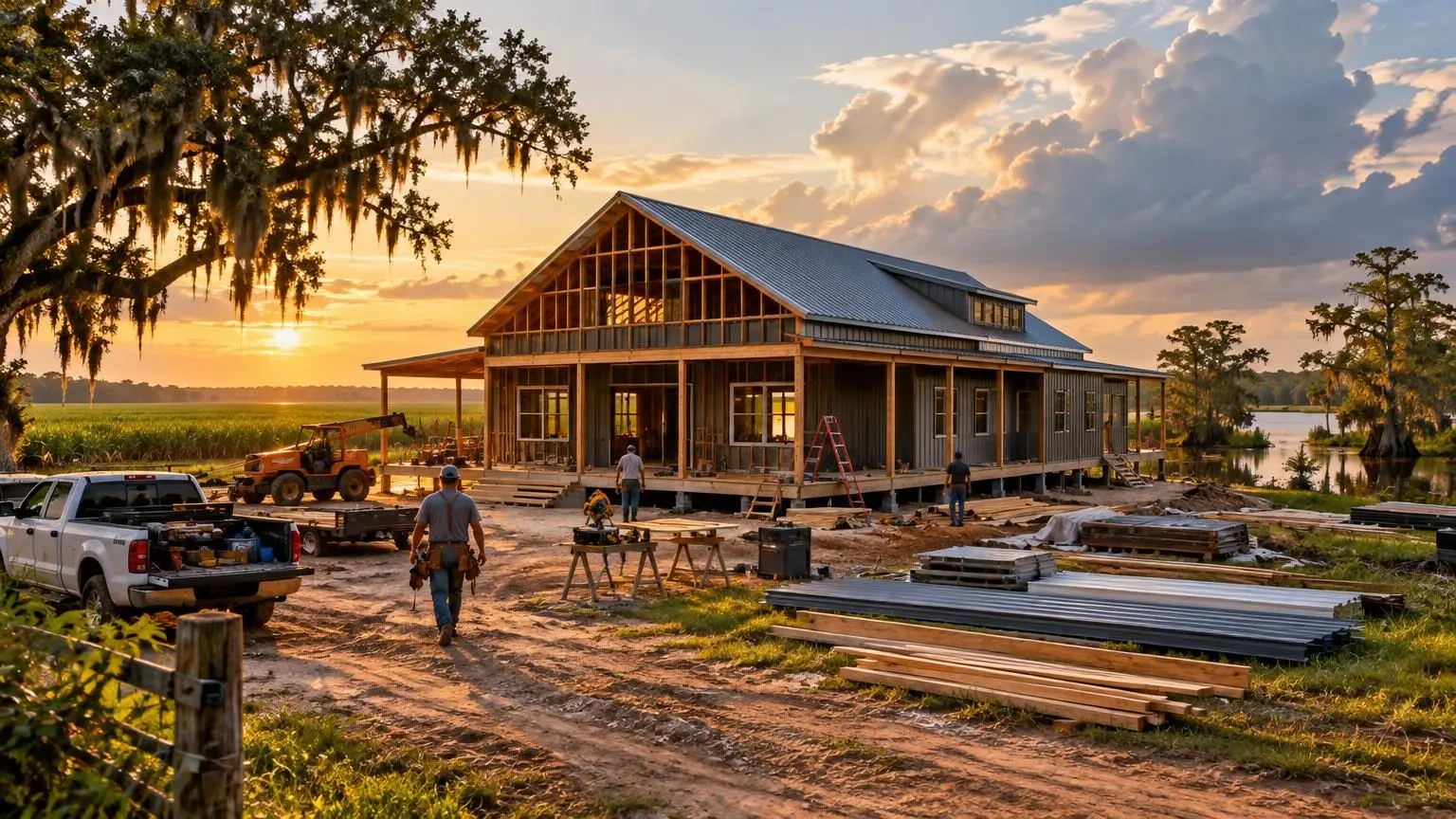
Barndominium builders looking at Opelousas see a small city at the center of a big, mostly rural parish. Opelousas is the seat and the largest city of St. Landry Parish, a parish of about 939 square miles that counted 82,540 people in 2020. The city itself covers about 9.67 square miles of land and had 15,786 residents at the 2020 census. Do the arithmetic and you see why a barndominium makes sense here: most of the parish is open country, and a home with a working shop usually fits best on acreage outside the city grid.
How old is this ground, really?
Older than most of Louisiana. The parish history traces the Opelousas Post to 1764. On April 10, 1805, the post was named the town of Opelousas and became the seat of the County of Opelousas, and on April 14, 1807, it was designated the seat of St. Landry Parish. After Baton Rouge fell to Union troops in 1862, Opelousas served as the state capital for nine months. For a builder, that long history means old property lines, old family tracts that get divided among heirs, and rural roads laid out long before anyone thought about a 60-foot steel building. A current survey is one of the first things we ask for.
Is the city growing or holding steady?
The Census Bureau estimates 15,098 people in Opelousas in July 2025, about 4.6 percent below its 2020 base. The parish moved the same direction, from 83,384 in 2010 to 82,540 in 2020. That is a different setting from the fast-growing suburbs to the south. Land around Opelousas tends to come in larger, older pieces, and there is less pressure from new subdivisions boxing in a rural lot. It also means appraisers may find fewer recent comparable sales for a new barndominium, which is something to raise with your lender early.
What does the soil do?
Loess-derived terrace soils are common in this part of the state. The USDA's Patoutville series, a south Louisiana soil formed in loess on nearly level terraces with its type location in neighboring Acadia Parish, is described as somewhat poorly drained with slow permeability and wet layers starting anywhere from half a foot to three feet down. Soils like that can hold water close to the surface in the wet season. On terrace ground we plan a raised building pad, a slab design matched to a soil report, and swales or ditches that carry rainwater off the site rather than letting it pool along the foundation.
Who reviews the plans?
Inside Opelousas city limits, the city's zoning and permitting apply. On the rest of the parish's land, including around communities like Grand Coteau, Leonville and Lawtell, you are generally dealing with St. Landry Parish rather than a city. We verify jurisdiction for your parcel before anything is drawn in detail. Wherever the lot sits, Louisiana's statewide code now follows the 2021 International Residential Code, in effect since January 1, 2023, with Energy Code inspections for homes and updated roof requirements including secondary barriers.
What about septic on a country tract?
Outside sewer service, an onsite system is part of the plan. Louisiana's onsite wastewater program places permitting with sanitarians in each parish health unit, and the state recognizes several system types, from a septic tank with a field bed to mechanical plants with drip, mound, spray or overland disposal. Slow-draining terrace soils can limit which ones work, so we position the house and shop only after the wastewater area is understood.
What fits on Opelousas acreage?
- A barndominium home with an attached or detached shop
- Equipment barns with living quarters for farm or ranch property
- Shop houses with wide bays for trailers and trucks
- Custom floor plans sized to the buildable part of a tract
Whatever you build, we start from the survey, the soil and the jurisdiction, then design the frame and floor plan around them. Tell us about your St. Landry Parish land at (225) 320-7298, or
.Opelousas and St. Landry Parish Facts
- Parish seat. Opelousas is the seat and largest city of St. Landry Parish, designated parish seat on April 14, 1807.
- Wartime capital. After Baton Rouge fell to Union troops in 1862, Opelousas served as the state capital for nine months.
- City size. 15,786 residents in the 2020 census on about 9.67 square miles of land; estimated 15,098 in July 2025.
- A large rural parish. St. Landry Parish covers about 939 square miles and had 82,540 residents in 2020.
- Neighbors. The parish borders Avoyelles, Pointe Coupee, St. Martin, Lafayette, Acadia and Evangeline parishes.
Our Services in Opelousas, LA
Opelousas Questions
Do I need a new survey for an old family tract near Opelousas?
Usually yes. Old parish tracts often have dated or unclear boundaries, and the building, drive and septic area all have to be placed against accurate lines.
Will an appraiser have trouble valuing a barndominium here?
It can happen when there are few recent sales of similar homes. Talk to your lender early about how they handle comparables for a barndo.
Does St. Landry Parish or the city permit my build?
Inside Opelousas city limits it is the city; elsewhere it is generally the parish. We confirm it for your parcel first.
What septic options exist for wet terrace soils?
Louisiana allows conventional tanks with field beds plus several mechanical systems. The parish health unit sanitarian reviews which one fits your site.
Free Estimates in Opelousas, LA
Free estimates for barndominiums around Opelousas.
Barndominium Builders Near Opelousas
- Barndominium Builders in Baton Rouge, LA
- Barndominium Builders in Denham Springs, LA
- Barndominium Builders in Walker, LA
- Barndominium Builders in Gonzales, LA
- Barndominium Builders in Prairieville, LA
- Barndominium Builders in Zachary, LA
- Barndominium Builders in Central, LA
- Barndominium Builders in Hammond, LA
- Barndominium Builders in Ponchatoula, LA
- Barndominium Builders in Covington, LA
- Barndominium Builders in Mandeville, LA
- Barndominium Builders in Slidell, LA
- Barndominium Builders in Houma, LA
- Barndominium Builders in Thibodaux, LA
- Barndominium Builders in Lafayette, LA
- Barndominium Builders in Broussard, LA
- Barndominium Builders in Youngsville, LA
- Barndominium Builders in New Iberia, LA
- Barndominium Builders in Abbeville, LA
- Barndominium Builders in Lake Charles, LA
- Barndominium Builders in Sulphur, LA
- Barndominium Builders in DeRidder, LA
- Barndominium Builders in Alexandria, LA
- Barndominium Builders in Natchitoches, LA
- Barndominium Builders in Shreveport, LA
- Barndominium Builders in Bossier City, LA
- Barndominium Builders in Monroe, LA
- Barndominium Builders in West Monroe, LA
- Barndominium Builders in Ruston, LA